This week will not be abnormal
Starting to think this is what the takeoff feels like
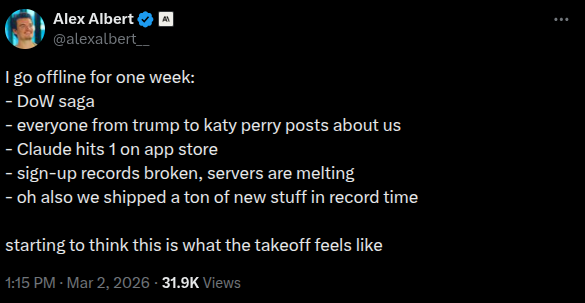
I. This week felt abnormal
For many, the last 7 days have felt particularly eventful. In fact, this feels like the first week in a while where the all-encompassing feeling of accelerating change - both good and bad - has screeched out of SF and into dining rooms, offices, and barracks around the country.
It is the first week in a while where the full force of the federal government collided and cooperated with the furious speed of frontier AI. It is the first week in a while where the hum of a datacenter felt as important as the arc of a missile. This week felt especially strange and powerful - like the kind of week we will look at in a year and say perhaps not "that one changed everything," but at least "that one was crazy."
Unfortunately, I don't think this will have been crazy. I'm starting to think this is what the takeoff feels like. And if this is what the takeoff feels like, we have to adapt to this feeling.
II. This week will not be abnormal
This is what an eventful week looks like when the government doesn't believe AI may be truly transformative, when most of the key decision-makers in the national security state have not seriously thought about a country of geniuses in a datacenter, and what that means for the fragility of mutual deterrence, and the promises of global security, and the balance of everyday trade, and all the other important things that key decision-makers fret about.
This is what an eventful week looks like when less than one percent of the world uses AI.
We have not yet seen massive state-sponsored, AI-powered attacks on power plants and hospitals, nor have we seen truly realistic deepfakes swing an election. We have not yet seen mortgage defaults spike as remote jobs get automated, or autonomous drone swarms fire on civilians in war. There are no marches on DC for AI personhood or Congressional interns frantically drafting labor protection bills over the weekend. There are no AI-enabled coup attempts from despots or engineered bioweapons released by terrorists.
But, if the graphs keep going up - and the graphs do keep going up - then these things are coming. And even if we delicately avoid the worst, even if we see gravity-defying consumer surplus and an ever-increasing number of diseases with Wikipedia articles written in the past tense, the world will still feel very fast, and very strange. First every month, and then every week, and then every day, and then every hour, there will be a million million more technologies no human has ever understood and culture no human has ever touched.
So, when we look back on March 3rd, 2027, I suspect this week will have felt slightly uneasy, but not ridiculously so. Perhaps we will even think of this week as having been part of a period of nervous calm, when people started to realize that things are different now.
III. The urgent importance of staying sane
So, what does this mean? It means you must stay sane. You must retain (or gain!) your ability to make good strategic decisions when the world you knew feels like it's falling apart and every week feels like a decade. You must retain the ability to put down Twitter and go for a walk; to check the news, see the latest horror, and carry on anyways. You can't help people if you're paralyzed, and there will be intense pressure on your spinal cord in the next five years.
One of the skills that I think will matter for a bit, more than agency or taste or whatever new word best describes general competence at doing useful things, is making good strategic decisions under adversarial fog. By adversarial fog, I mean a world where you have very little idea of what's actually going on, and some of the people that are telling you what's going on are probably lying and definitely biased. In adversarial fog, you ingest information voraciously and incorporate it suspiciously. You understand that things might change quickly, and that friends and confidants may be mistaken, or compromised, or just plain incorrect. And you do all of this while trying to be kind and generally not panic.
This probably does not mean cutting yourself off from important data; if intelligence is cheap, the other kind of intelligence still matters. And, after all, you'll probably make better strategic decisions if you know more about what matters.
This also doesn't mean compartmentalizing the strangeness and dread of it all. This strange dread, in moderate amounts at moderate times, might be useful to internalize, because it's probably the "right" emotion - it's what someone in our situation would reasonably feel. Lying to oneself to feel better is probably not great for decision-making, but of course neither is lies to oneself that make you feel worse.
I don't know what the answers are here. I don't have enough life experience to be confident in them even if I did. Yet, I am preparing to live in a world of common abnormal weeks in adversarial fog, and I hope you consider joining me.
I wrote this in 90 minutes to win a bet. I hope to publish more polished work soon! To get new posts, follow me on Substack or subscribe to my RSS feed.